
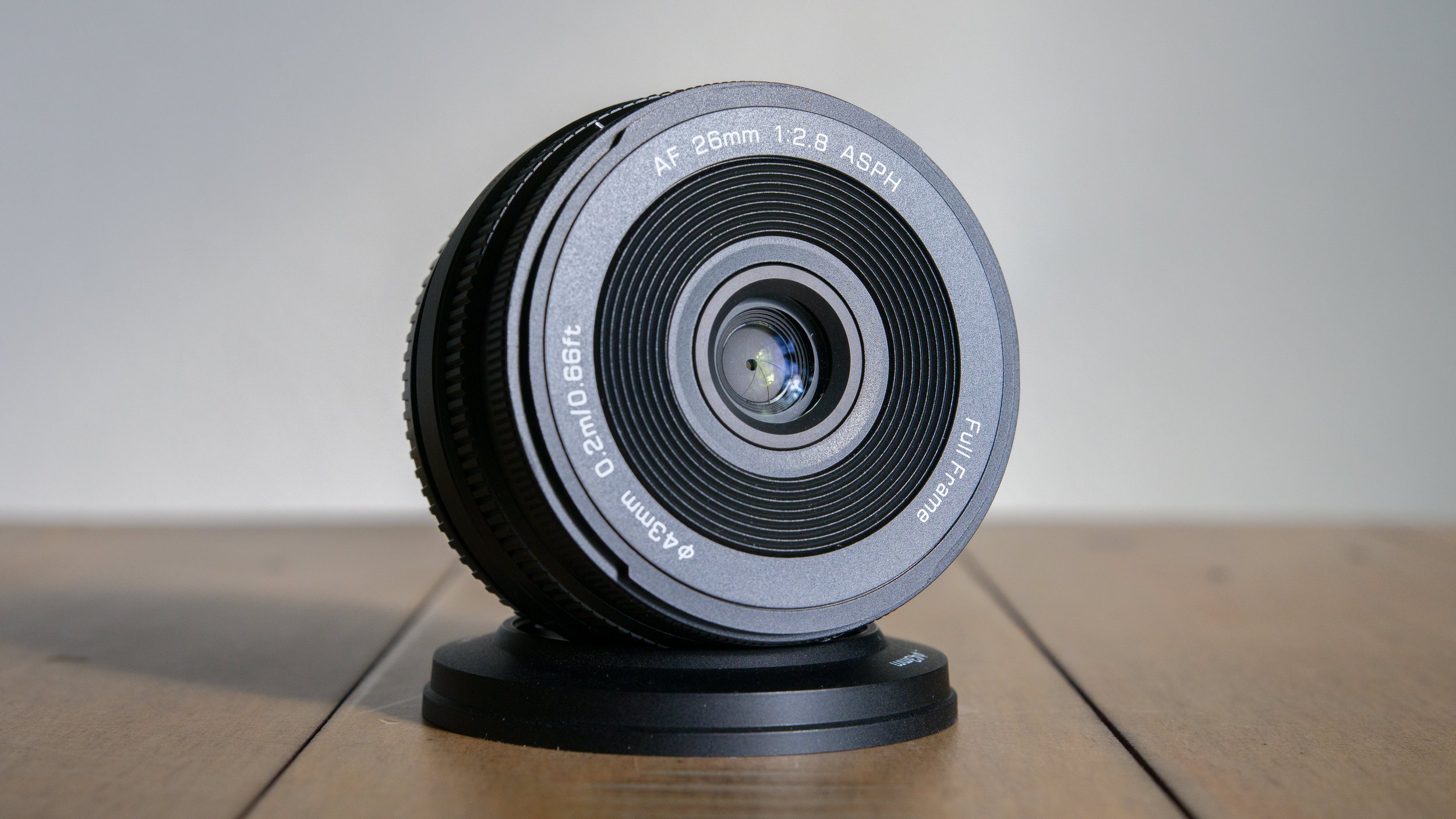
Viltrox 26mm EVO Review Preview
Viltrox AF 26mm F2.8 EVO pancake lens for Nikon Z

Authorized review repost

First Look: Viltrox AF 26mm F2.8 EVO for Nikon Z

A full-frame pancake with a hidden APS-C strength—compact, optically impressive, and more nuanced in handling than its dimensions suggest.

By Scott TuckerOriginal article: July 15, 2026Photography © Scott Tucker

Review context

A Detailed First Look, Not a Final Laboratory Review

Scott Tucker received less pre-release time with the 26mm F2.8 EVO than he usually has with a new lens, so he presented this as a first look. Even so, his time with the lens was sufficient to evaluate its physical controls, autofocus behavior and optical character across full-frame and DX-crop shooting.

The lens was provided by Viltrox free of charge in exchange for his independent thoughts. Viltrox did not review or approve Scott's article before publication. The original article contains affiliate links.

Watch inside the article

Scott's Video First Look

The video is embedded here for convenience. The supporting review link continues to Scott's website article rather than linking away to YouTube.

01

Strongest Point

Sharp, pleasing images from a body small enough for everyday carry.

02

Most Notable Compromise

Very slim control surfaces and an aperture-ring direction that differs from larger Z-mount EVO primes.

03

Best Hidden Use

Mounted on Nikon DX, 26mm becomes a natural-feeling approximate 39–40mm equivalent.

The lens

Price, Specifications and Scale

Scott's pre-release article listed a 130g weight and six aperture blades. The current official retail page lists approximately 170g for the bare lens and seven blades, so the specification card below follows the current production information. Pricing and regional offers can change.

Weight≈170 g
Filter43 mm
ApertureF2.8–F16
Diaphragm7 blades
Minimum focus0.2 m / 7.8 in
Magnification0.2×
Focus motorGear-type STM
FirmwareInternal USB-C port
Front protectionMagnetic cap
MountRubber gasket

Build quality and handling

Familiar EVO Construction, Redesigned Around a Pancake Body

The metal mount, close fit and familiar material finish immediately connect the 26mm to the larger EVO primes. The very short barrel, however, forces its controls into a different layout. Scott found that the lens retains a solid, reassuring feel in hand, but does not always deliver the same effortless control experience as the 35mm, 55mm and 85mm EVO lenses.

01

Aperture Ring Direction

On the 26mm, the aperture values are printed on the fixed barrel while a dot rotates with the ring. That makes the ring turn in the opposite direction from the larger Nikon Z EVO lenses. Scott found the change repeatedly worked against established muscle memory.

02

Manual-Focus Ring

The focus ring is nearly flush with the barrel and its texture is subtle. Scott often needed to look down at the lens to place a fingertip accurately instead of locating the ring by touch.

03

Mounting Grip

Because so much of the small exterior is made of moving rings, mounting and removing the lens can unintentionally change the selected aperture.

Hood, filters and cap

A Useful Solution with a Few Practical Trade-Offs

The removable dome-style hood contains the 43mm filter thread, adding filter support that the earlier 28mm F4.5 Chip lacked. Scott would have preferred a more common 52mm thread, as 43mm filters may require an adapter for an existing kit.

The magnetic front cap can be used with or without the hood, but a step ring and filter can remove some of the convenience of the compact magnetic setup.

Scott's build verdict is deliberately mixed: the physical construction feels secure and well-finished, but the compressed controls make the lens feel less natural “EVO” in operation.

Editorial summary of the original first look

Autofocus performance

Best Approached as a Deliberate Walkabout Lens

Scott found the 26mm to be the slowest-focusing EVO lens he had used at that point. AF-S gave him the most dependable results. In moderate or low light, especially above approximately ISO 1000 in his Nikon Z use, the lens could pulse while searching for contrast and occasionally report focus without a truly sharp result.

The gear-type stepping motor is more audible than the motors in the larger EVO primes. Scott therefore would not choose it for fast subjects moving toward or away from the camera, nor for autofocus video recorded with an onboard microphone.

His test lens arrived with firmware 1.03, while firmware 1.04 became available shortly before publication. Later firmware may refine behavior, so current users should keep the lens updated.

Recommended

AF-S, street scenes, travel, posed people, landscape details and slower everyday subjects.

Less Suitable

Fast action, unpredictable subjects, quiet onboard-audio video and demanding low-light tracking.

Image quality

The Optics Are the Reason the Lens Ultimately Succeeds

Once Scott moved beyond the handling choices and measured autofocus, the files consistently surprised him. Color was pleasing, the central two-thirds of the frame stayed sharp even at F2.8, and the embedded correction profile provided useful control of distortion and vignetting in JPEG and compatible RAW workflows.

Comparison 01

Embedded Profile Correction

Drag the divider to compare the author's example with lens corrections disabled and enabled.

Corrections enabled
Corrections disabled
Corrections disabled Corrections enabled
Original comparison by Scott Tucker. The embedded profile corrects distortion and vignetting.
Comparison 02

FX 26mm Versus DX Crop

The strong central image area creates a compelling approximate 39–40mm equivalent on Nikon DX bodies.

DX · ≈40mm equivalent
FX · 26mm
FX · 26mm DX · ≈40mm equivalent
Same vantage point shown at the full-frame field of view and in Nikon DX crop mode.
Comparison 03

Camera Standard JPEG Versus Processed RAW

Scott described the native rendering as fairly neutral and often added some contrast and saturation during post-production.

Processed RAW
SOOC JPEG
SOOC JPEG Processed RAW
A comparison of the camera-standard JPEG and Scott’s subtly processed RAW result.

Sharpness and DX use

More than Center Sharpness

Scott was impressed that clarity extended well beyond the center. By F8, he found the outer image area as crisp as he would expect from a pancake design, with little visible fringing.

That strong center and mid-frame performance is also what makes the lens especially interesting for Nikon Z DX cameras such as the Z fc, Z30, Z50 and Z50 II.

≈39–40mm equivalent0.2m close focus45MP-capable detail

Close focus

Useful Separation at F2.8

The deeper 0.2× magnification lets the lens move close enough to soften the background while retaining strong center detail.

Bokeh shape

Controlled Rather than Character-Heavy

Highlights remain fairly round, with little swirl or cat-eye deformation; colored outlines can appear around some specular highlights.

Chromatic Aberration

Very well controlled for a lens this small, with only limited fringing along difficult bright edges.

Flare Resistance

A major improvement over the 28mm Chip when the sun is partly obstructed or just outside the most demanding position.

Veiling Flare

Still possible in harsh light, though smaller and less distracting than the earlier ultra-thin lens.

Sunstars

Not a signature strength; Scott did not consider the diffraction trade-off worthwhile solely to generate them.

Image-quality verdict

Sharp, Consistent Files Redeem the Lens's Operational Compromises

Scott found excellent center and mid-frame sharpness, clean results at close focus, restrained bokeh and strong control of chromatic aberration. In his editing, the files never felt as though they were falling apart, even on a 45MP Nikon body.

Conclusion

A Flawed But Highly Capable Compact Lens

Scott sees the 26mm F2.8 EVO as a light-travel and lifestyle lens rather than a smaller version of the more professionally oriented EVO primes. The handling decisions and autofocus behavior keep the verdict from being uncomplicated praise.

What changes the final assessment is image quality. For photographers capturing travel, street scenes, landscapes, quiet family moments and slower subjects, it produces pleasing, detailed results in a very small package.

He considers the 26mm a substantially more compelling choice than the 28mm F4.5 Chip because the extra optical quality, variable aperture and filter support justify the added cost. On Nikon DX, the natural 39–40mm-equivalent view may be the lens's most persuasive use case.

Why it Works
  • ·Strong center and mid-frame sharpness from F2.8
  • ·Compact ≈170g all-metal construction
  • ·Useful close-focus ability
  • ·Filter support and embedded corrections
  • ·Excellent approximate 40mm option on Nikon DX
What to Understand First
  • ·Opposite aperture-ring direction versus larger Z EVO primes
  • ·Very slim manual-focus control
  • ·Measured autofocus in lower light
  • ·Audible stepping motor
  • ·Less common 43mm filter size
ST

Scott Tucker Photography

Independent photographer and reviewer. This authorized repost retains Scott's disclosure, critical observations, comparison images and sample photographs.

Read Scott's Full Website Article ↗

Official product information

Viltrox AF 26mm F2.8 EVO for Nikon Z

Check current regional availability, specifications and pricing on the official Viltrox product page.

Title

Explore More Lenses

Discussion

Comments (0)

No approved comments yet.

Leave a comment

Comments are open to everyone — feel free to share your thoughts!

Previous Post

Share this post

Next Post