

5K full-frame Open Gate
The FX5 is the first Sony Cinema Line FX camera with full-frame 3:2 Open Gate. At launch, Open Gate is available in X-OCN, giving editors more vertical image area for 16:9, 9:16, square and anamorphic reframing.
Official specifications · New cinema technology · Lens recommendations
Sony has officially introduced the FX5 with a new 5K full-frame stacked sensor, internal X-OCN, Open Gate, BIONZ XR2 AI processing and Dual Gain Shooting. Here is what changed—and how to choose a Viltrox lens around the new camera.
Sony Cinema Line · Official launch brief
On July 22, 2026, Sony officially announced the FX5, a compact full-frame Cinema Line camera built around a newly developed stacked Exmor RS sensor and the BIONZ XR2 engine with integrated AI processing.
Its full-frame Open Gate capture and internal X-OCN workflow create new demands on optical resolution, aberration control, autofocus behaviour and lens metadata. That makes lens selection part of the production workflow—not an afterthought.

Sony FX5 body and control layout
The product views below help readers understand the FX5 body design, controls and connection layout before the article moves into recording technology and lens selection.


Official Sony FX5 specifications
Sony positions the FX5 as a compact professional cinema camera for run-and-gun production, documentary work, independent filmmaking and larger rigged sets. The specification sheet combines a newly developed sensor with professional recording, monitoring and connectivity tools.
View Sony's official specifications ↗What is genuinely new?
The FX5 is more than a resolution update. Its biggest changes affect acquisition, exposure, monitoring, autofocus, audio and post-production.
The FX5 is the first Sony Cinema Line FX camera with full-frame 3:2 Open Gate. At launch, Open Gate is available in X-OCN, giving editors more vertical image area for 16:9, 9:16, square and anamorphic reframing.
X-OCN LT, C1 and C2 can be recorded inside the camera, providing a scene-linear RAW workflow without an external recorder. This is a major upgrade for compact rigs and high-end post-production.
Dual Gain Shooting debuts in the Cinema Line FX series. It is designed to maximise latitude and reduce shadow noise, complementing the three Base ISO settings.
The new engine combines image processing and AI functions. It supports advanced subject recognition and deep-learning-based Auto Tracing White Balance for more stable colour under difficult lighting.
Fast Hybrid AF uses up to 759 phase-detection points, with human, animal and bird recognition, Real-time Eye AF and Real-time Tracking for moving subjects and shallow depth of field.
Built-in de-squeeze settings include 1.3×, 1.5×, 1.6×, 1.8× and 2.0×, helping crews monitor anamorphic images correctly on set.
Waveform Monitor, Histogram, False Color and Focus Map support exposure and focus decisions, while the CineAlta-inspired BIG6 screen keeps six critical settings visible together.
The XLR-H2 handle supports up to 96kHz/32-bit float four-channel audio. Wired LAN, 2.4/5/6GHz Wi-Fi and dual USB-C connections support remote control, transfer, timecode and power.

Sony's launch announcement confirms these maximum frame rates. Full-frame 3:2 Open Gate is available with X-OCN recording.
Sony states that 5K 3:2 X-OCN 120p and 4K 240p require a future firmware update. Additional planned support includes XAVC S-I 3:2 full-sensor recording, a vertical interface and Frame Grab.
Open Gate and image scan modes
The FX5 does not treat every recording mode as the same crop. Sony provides full-frame, full-frame crop and Super 35 scan windows so crews can trade field of view, resolution and frame rate for the needs of each shot.
Simplified visualisation for explaining relative sensor coverage. It is not official Sony artwork and is not a pixel-accurate scale drawing.
Open Gate reads the full 3:2 sensor area, preserving extra image above and below a conventional widescreen frame. That gives editors more freedom for 16:9, vertical, square and anamorphic deliverables.
The full 3:2 readout is the most flexible choice when one shoot must feed landscape, vertical and cinematic deliverables.
A smaller scan window narrows the effective angle of view. The same prime becomes visually tighter without changing the physical lens.
The S35 scan window makes APS-C coverage relevant for supported workflows, but it should never be presented as full-frame or Open Gate coverage.
At launch, Sony confirms recording up to 5K 60p, 4K 120p and Full HD 240p. The headline 5K 3:2 X-OCN 120p and full-frame-crop 4K 240p modes require a future firmware update. Sony also plans XAVC S-I 3:2 Open Gate support through version 2.0 in or after August 2027. With Dual Gain Shooting, Sony states support up to 30p in FF 5K 3:2 and up to 60p in FF 5K 16:9 or 17:9.
Sony's mode chart is a strong visual hook, but the footnotes make the article genuinely useful. They explain what is available now, where Dual Gain changes the operating envelope, and why X-OCN places more responsibility on the lens and post-production workflow.
The launch specification is up to 5K 60p, 4K 120p and Full HD 240p. Sony plans 5K 3:2 X-OCN 120p and full-frame-crop 4K 240p for software version 2.00 in or after August 2027.
With Dual Gain enabled, Sony lists up to 30p in FF 5K 3:2 and up to 60p in FF 5K 16:9 or 17:9. Base ISO is fixed at 800, and the mode is unavailable in FF crop 4.5K, FF crop 3.8K and Full HD.
Sony states that in-camera lens distortion correction is not applied to internally recorded X-OCN clips. Compatible Catalyst workflows may use embedded lens metadata later, so optical distortion, edge quality and verified metadata behaviour become more important when recommending lenses.
FF 5K 3:2, 16:9 and 17:9 require a full-frame image circle. Open Gate also makes corner performance and distortion more visible.
AF 27mm, 56mm and 75mm F1.2 Pro can be discussed only for supported Super 35 workflows—not as full-frame or Open Gate lenses. Final FX5 compatibility still requires testing.
Internal X-OCN gives FX5 users more grading latitude and a richer post-production pipeline. But a RAW-first workflow also puts more responsibility on the optical system instead of relying on a baked-in look.
Resolution, chromatic aberration control, distortion behaviour, autofocus and focus breathing all become part of the final image.
That is why the right recommendation is not one universal lens kit. It is a choice between four Viltrox product lines, each built for a different balance of image quality, speed, size and production style.
01 / Flagship image quality
Peak resolution for demanding RAW workflows
For productions that want the highest optical standard, LAB prioritises fine detail, aberration control, low-light performance and professional physical operation.
 135
135For compressed portraits, performance coverage, detail-rich close-ups and cinematic separation when distance is available.
 35
35For narrative scenes, environmental portraits, night production and wide-aperture storytelling with more context around the subject.
02 / Professional all-round performance
High resolution with more everyday versatility
For creators who need professional sharpness, fast apertures and responsive autofocus across interviews, portraits, dialogue and commercial production, Pro offers a strong balance of performance and flexibility.
 50
50A natural full-frame perspective for dialogue, product work, medium portraits and controlled focus transitions.
 85
85For interviews, emotional close-ups, beauty work and subject isolation with natural portrait compression.
03 / Performance and size in balance
APO colour control for mobile production
EVO is designed for creators who want a refined balance of optical performance, practical size and everyday handling. Its APO approach helps keep colour fringing under control while supporting fast-moving documentary and hybrid workflows.
 35
35For street, travel, documentary, vlogging and environmental scenes where context is as important as the subject.
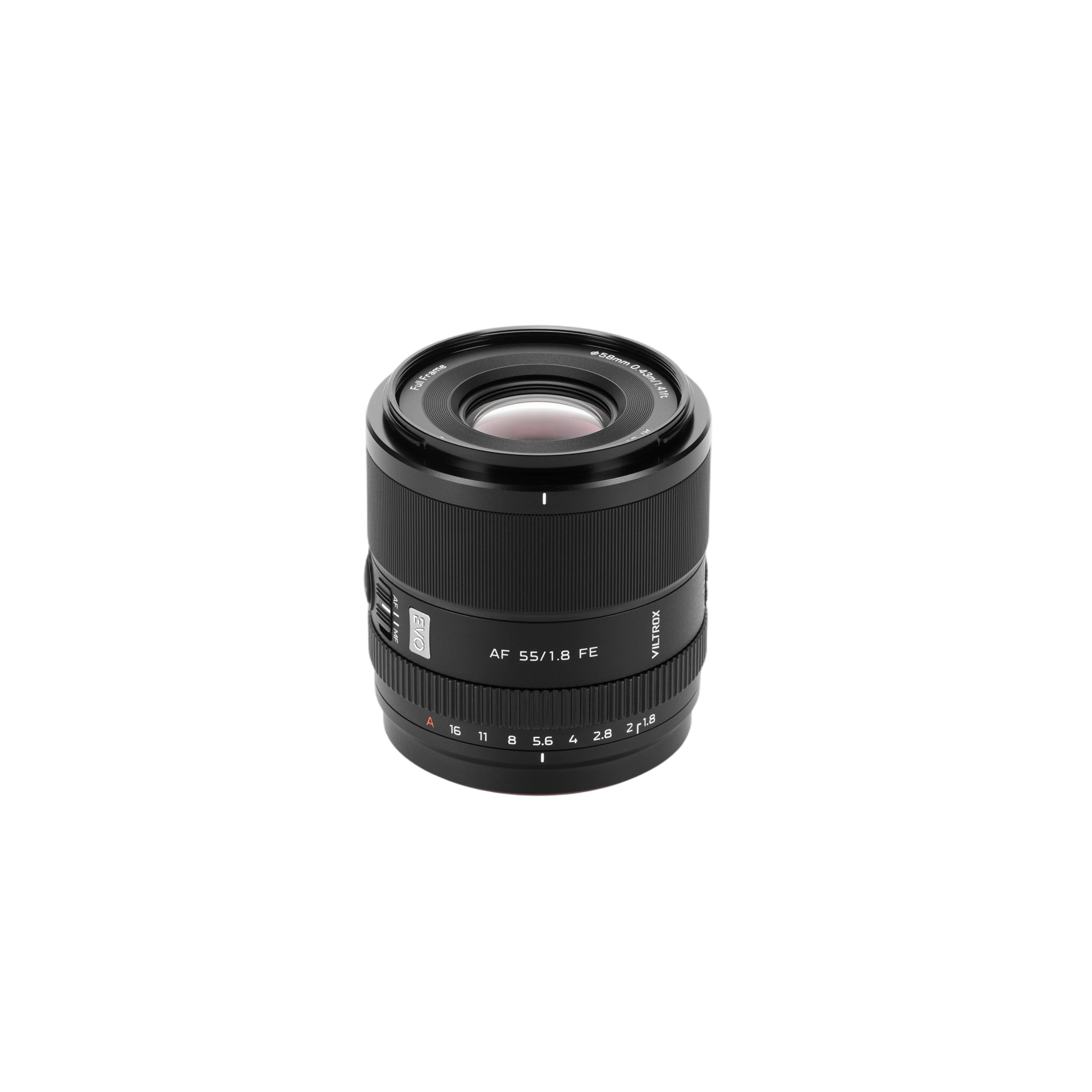 55
55For everyday visual storytelling, lifestyle content, natural portraits and a comfortable standard perspective.
04 / Special crop-mode option
F1.2 flagship optics for crop workflows
For creators intentionally working with a supported APS-C or Super 35 crop workflow, the Pro trio extends Viltrox's flagship APS-C optical design across a useful set of equivalent focal lengths.
 27
27Approximately 40mm full-frame equivalent: a natural perspective for street, documentary, travel and everyday narrative coverage.
 56
56Approximately 85mm full-frame equivalent: built for interviews, portraits and close-ups with strong subject isolation.
 75
75Approximately 115mm full-frame equivalent: a compressed telephoto option for detailed portraits and isolated compositions.
Choose by production priority
The same FX5 body can serve very different crews. Choose the product line that matches the job, then refine focal length around the shot list.
Prioritise edge-to-edge detail, aberration control and large-aperture rendering.
Start with LABBalance strong optical performance with practical standard and portrait focal lengths.
Start with ProKeep the setup more manageable while maintaining full-frame coverage and APO colour control.
Start with EVOUse only when the selected recording mode supports an APS-C crop and compatibility is verified.
Consider APS-C ProCompatibility comes before recommendation
A native E-mount fit does not automatically confirm cinema-workflow compatibility. The complete camera and lens system should be tested in the modes a crew actually plans to use.
Focus stability, transition behaviour and subject recognition across working distances.
Correct focal length, aperture, lens ID and production metadata in every codec.
Focal-length reporting, stabilisation behaviour and post-production metadata.
Distortion, shading and chromatic-aberration correction in camera and post.
Framing consistency during focus transitions and compensation support where available.
Reliable communication during X-OCN, crop modes and extended high-frame-rate recording.
Sony FX5 FAQ
These answers use Sony's official launch information. Planned firmware functions are clearly separated from features available at launch.
The FX5 uses a newly developed 35mm full-frame stacked Exmor RS CMOS sensor with approximately 16.6 effective megapixels and BIONZ XR2 processing with integrated AI.
Yes. It supports full-frame 5K 3:2 Open Gate, a first for Sony's Cinema Line FX series. At launch, Open Gate recording is available with X-OCN.
Sony lists full-frame 5K 3:2 Open Gate, full-frame 5K 16:9 and 17:9, full-frame crop 4.5K 16:9 and 17:9, full-frame crop 3.8K 16:9, and Super 35 3.2K 16:9. Available frame rates depend on codec, scan mode and firmware version.
Yes. The camera records 16-bit scene-linear X-OCN internally in LT, C1 and C2 variants, reducing the need for an external RAW recorder.
The three Base ISO values are ISO 800, ISO 4000 and ISO 12800. Manual selection depends on the selected exposure mode.
No. The launch specification supports up to 5K 60p, 4K 120p and Full HD 240p. Sony plans to add 5K 3:2 X-OCN 120p and cropped 4K 240p through a future firmware update.
Sony lists up to 30p in FF 5K 3:2 and up to 60p in FF 5K 16:9 or 17:9 with Dual Gain Shooting. Base ISO is fixed at 800, and the function is unavailable in several crop modes and Full HD.
No in-camera distortion correction is applied to internally recorded X-OCN clips. Sony states that supported correction can be applied later in compatible Catalyst software when the required lens metadata is available.
LAB suits maximum image-quality workflows, Pro covers professional standard and portrait production, and EVO balances full-frame performance with mobility. APS-C Pro lenses require a supported crop workflow. Formal compatibility claims should wait for production-camera testing.
Official references
Sony's launch announcement and specification pages are the primary references for FX5 features. Viltrox product pages provide the latest lens specifications and availability.
Launch-day information covering the sensor, frame rates, Open Gate, X-OCN, release timing and planned firmware features.
Open Sony announcement ↗Official details for Open Gate, image scan windows, internal X-OCN, frame rates, Dual Gain Shooting and planned firmware functions.
Open Sony FX5 features ↗Current full-frame E-mount flagship and professional prime lens information.
Explore LAB and Pro lenses ↗Current EVO full-frame primes and APS-C Pro lens pages for Sony E-mount.
Explore Sony E-mount lenses ↗Explore Viltrox E-mount lenses for flagship image quality, professional production and mobile filmmaking.


Discussion
Comments (0)
No approved comments yet.